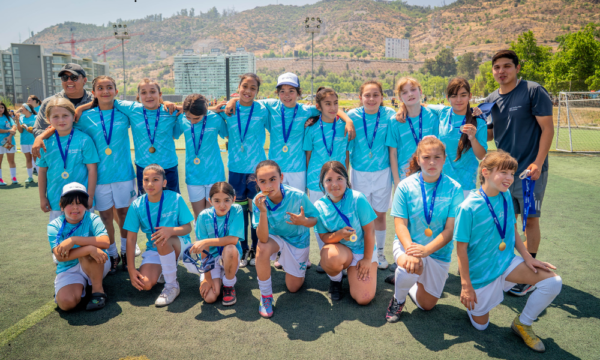
Rosario Donoso, Director of Sports: “Every training session is an opportunity to strengthen self-esteem.”
The Sports Schools program, active since 2019 in regions such as the Metropolitan Region and Antofagasta, promotes life skills with a non-competitive approach that integrates families, seeking to have an impact on coexistence, self-esteem, and the educational trajectories of children.
In Chile, a growing number of institutions and public programs are analyzing the impact of social-emotional skills on educational trajectories, school coexistence, and future opportunities. It is at this intersection of sports, education, and well-being that the work of the Luksic Foundation comes into play.
Since 2019, Fundación Luksic’s Sports Schools have worked with more than 3,000 children in regions such as the Metropolitan and Antofagasta, using a model that prioritizes the learning process over competition. The program also includes training for the teaching staff and workshops for families, extending its impact beyond the playing field.
Rosario Donoso, director of the Sports Department at the Luksic Foundation, explains that “when a child finds a safe space, adults who support them, and tools for development, their trajectories are strengthened and their possibilities for the future are expanded.”
She describes how “the skills that enable individuals to regulate their emotions, tolerate frustration, and adapt to difficult situations act as decisive protective factors in vulnerable contexts, as they have concrete effects on future trajectories, such as school retention, prevention of risky behaviors, labor market integration, and higher income throughout life.”
1. What motivated the Luksic Foundation to create the Sports Schools?
We work to support the development of social-emotional skills in children through sports. What does this mean? These are workshops designed to provide them with a safe place to play, but also where they can learn to manage emotions such as frustration and empathy, and to work as a team, with teachers trained to accompany them and their families.
Sports schools are part of the Foundation’s mission: to promote people’s abilities to generate well-being and thus contribute to Chile’s development. Because when a child finds a safe space, adults who accompany them, and tools for development, their trajectories are strengthened and their possibilities for the future are expanded. We seek to enable children to develop integrally, promoting their well-being, autonomy, and safety.
2. In addition to physical activity, what role does sport play in the emotional and social development of children who participate in this program?
The evidence is conclusive: skills that enable individuals to regulate emotions, tolerate frustration, and adapt to challenging situations serve as crucial protective factors in vulnerable contexts, as they have concrete effects on future trajectories—such as school retention, prevention of risky behaviors, labor market integration, and higher income throughout life.
Developing these tools requires a safe space, with trained adults and activities that allow these skills to be practiced in real life. We promote this space through sports, where each training session is also an opportunity to learn how to deal with frustration, empathize, and strengthen self-esteem, which are lessons that are then transferred to everyday life and the school environment.
3. Sports Schools have a non-competitive approach. Why was it important to make that decision, and what impact does it have on participants?
We decided that the focus should not be on winning or losing, but on the learning process. A non-competitive approach allows all children to participate without fear of making mistakes, regardless of their previous experience or starting point. This allows them to work on skills such as self-control, frustration tolerance, conflict resolution, and collaboration, which are integrated in a practical way into each training activity.
4. Since 2019, more than 3,000 children have participated in the program. What specific changes have you observed in them over time?
We have seen very significant progress, especially in emotional and social aspects. Many children are better able to express their feelings, relate more positively to their peers, and face challenges with greater confidence.
Several parents have told us about very specific changes at home. For example, they tell us that their children are now better able to manage their anger and frustration, and some have even reduced the use of coping mechanisms they used to help them concentrate, for example.
5. Why is it essential to involve parents and caregivers in this process?
Children’s development takes place mainly at home, which is why we must work on this aspect considering the entire system. Involving families allows us to reinforce learning and create more positive and supportive environments for children.
Through Positive Parenting workshops, we seek to provide mothers, fathers, and caregivers with tools to support their parenting efforts. We have seen that this strengthens family relationships and improves the way children’s emotional processes are accompanied.
To date, more than 700 parents from our schools have participated and learned positive discipline strategies to foster healthy bonds and children’s self-esteem and well-being.
6. ¿Por qué es relevante que este tipo de iniciativas sean completamente gratuitas y con entrega de equipamiento incluido?
Todo depende de cada proyecto; pero nosotros optamos por hacerlas gratuitas para eliminar las barreras de acceso, nuestro propósito es impulsar el desarrollo de los niños y niñas y aseguramos que las familias puedan participar con tranquilidad y que los niños se concentren en aprender y jugar.
7. What message would you give to families who are considering enrolling their children in these Sports Schools this year?
I would tell them that Sports Schools are more than just an after-school activity. They are a real opportunity for their children to continue developing skills that will shape their lives. It is a place where sport is experienced with respect and collaboration.
The application process is simple and can be completed online via the Luksic Foundation website www.fundacionluksic.cl until February 28. The application must be submitted by the parent or guardian responsible for the child during the application period.
Places are limited and, once selected, families are contacted by the Foundation team and receive all the information about school schedules and operations, which always take place after school hours throughout the year.