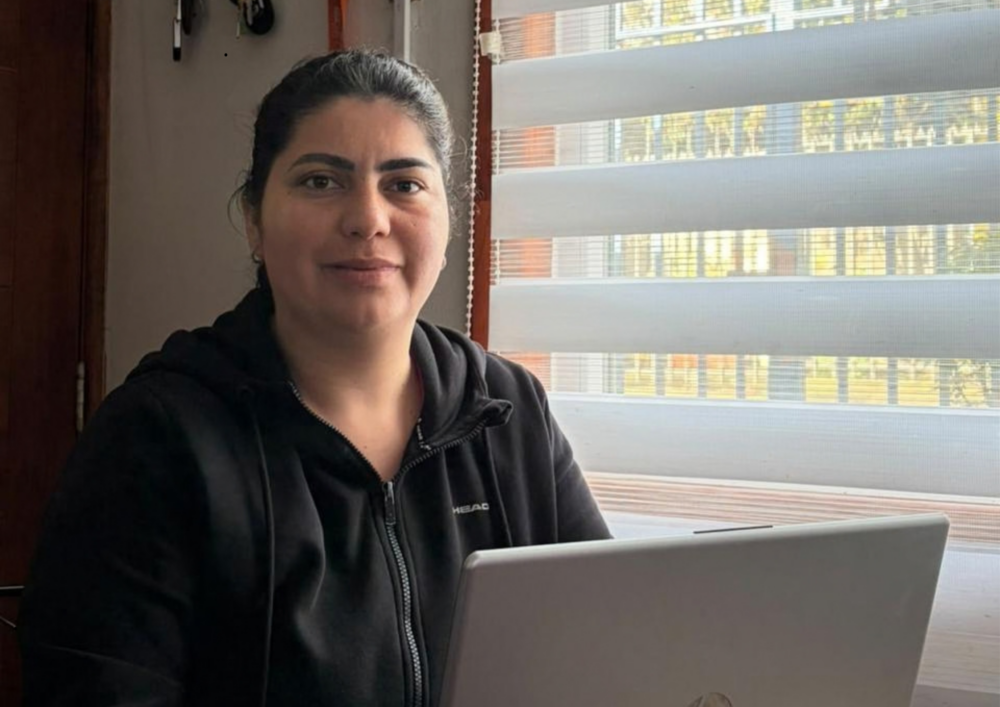
Carolina Vargas, the first professional in her family who chose to study Logistics Operations to build a new future
Carolina Vargas grew up in Purén, a small town in the Araucanía Region. After graduating with a degree in Occupational Therapy, she became the first professional in her family. Faced with limited job opportunities, she decided to go back to school and pursue a new path. Today, she is one of just four women in her cohort studying Logistics Operations at AIEP Temuco, while working and running a sewing business.
It is 11:00 p.m. when Carolina Vargas finally finishes her day. She works as an occupational therapist supporting a child, and twice a week, after finishing work, she gathers her things and heads to class. On Tuesdays and Thursdays, she studies until 11:00 p.m., and on Saturdays she is back in the classroom at 8:00 a.m. At 28, she is pursuing a second degree and is determined to finish it before turning 30.
Going back to school was not part of her plans when she earned her first degree. After years of hard work to become an occupational therapist, she expected to find a job that would allow her to grow professionally and pursue her dreams and goals. Unfortunately, that was not the case.
Carolina says she spent almost her entire life in Purén, a small town in the Araucanía Region with around 7,500 inhabitants, according to the latest census. Although her parents did not have the opportunity to complete their education during childhood—her father reached second grade and her mother sixth grade—she knew from an early age that she wanted to study. A teacher she met told her about university and encouraged her to look for a career she would enjoy. From then on, Carolina began imagining herself in higher education. With her teacher’s support, she learned about the options available to finance her studies, including the CAE student loan. Little by little, she discovered that she wanted to pursue a profession focused on caring for, supporting and improving the well-being of others.
In 2016, at the age of 18, Carolina left Purén and moved to Padre de Las Casas to study Occupational Therapy in Temuco, more than 150 kilometers from home. Before starting her degree, she worked harvesting blueberries to save money and cover her living expenses in the city. Even so, some expenses remained difficult to afford. When she did not have enough money for transportation, she would walk for an hour and a half from Padre de Las Casas to Temuco to get to class.
“When I got my first degree, I cried because I was the first person in my family to graduate from a professional program,” Carolina recalls emotionally. After completing her Occupational Therapy degree, she worked at the Purén Hospital. Then she began looking for new job opportunities, but options were limited. Many of the positions she found required experience or specialized training—opportunities she could not access precisely because she had not yet been able to enter the workforce.
After working for two years as a cashier at a hardware store, Carolina spent six months unemployed. During that time, she began looking for new alternatives and started a small sewing business with two machines. It was then that she came across an online advertisement for a Logistics Operations program. She began researching the field and discovered career opportunities she had not known about before.
“My dream is to find a good job and achieve financial and job stability,” she explains. Although it was a completely different field from what she had studied, she decided to enroll. Today, she is one of just four women in her cohort studying the program at AIEP.
Her decision also means entering a sector where women’s participation remains limited. According to an analysis by Conecta Logística, women account for 18.2% of the workforce in companies in the sector.
Carolina, however, does not simply envision herself joining the logistics workforce. “My goal is to one day be in charge of a company,” she says. “Studying Logistics also means showing that women can build careers in this field,” she adds.
This year, she was selected for Fundación Luksic’s Más Mujeres en STEM scholarship, which provides a monthly stipend that students can use at their discretion to help women pursuing higher-level technical degrees continue their studies and graduate on time.
For Carolina, this support is especially important because it helps her cover her monthly tuition: “You have to believe in your own dreams in order to move forward. Hopefully, one day we can look back and feel that we did a good job, despite all the difficulties,” she says.
A total of 300 women received this support between 2024 and 2026. The scholarship seeks to support students pursuing higher-level technical degrees related to science, technology, engineering and mathematics, so that more women can strengthen their skills, develop their talents and achieve their professional goals.