Global Pathways 2026 focuses on the implementation of social programs
Why do well-designed public policies not always succeed in closing gaps in social services? That was the question addressed by researcher Robyn Mildon at a conference organized by the Luksic Foundation, which brought together more than 300 people and discussed key challenges such as coordination between the central level and local governments, the capacities of the implementing teams and the excessive focus on new initiatives over the improvement of existing ones.
In this scenario, the conference “Global Pathways 2026: Quality Implementation to Make a Difference”, organized by the Luksic Foundation, put a key question on the table: why well-designed social programs do not always manage to scale, sustain over time, or generate the expected impact on people, focusing on how to improve implementation.
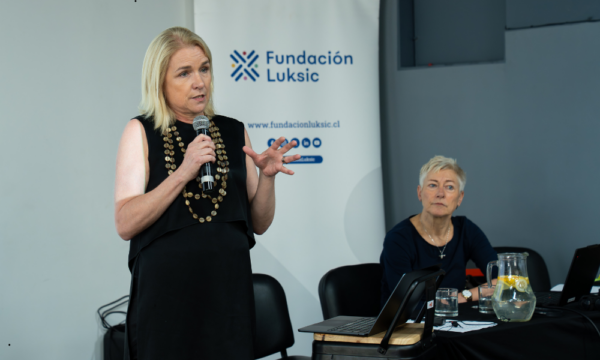
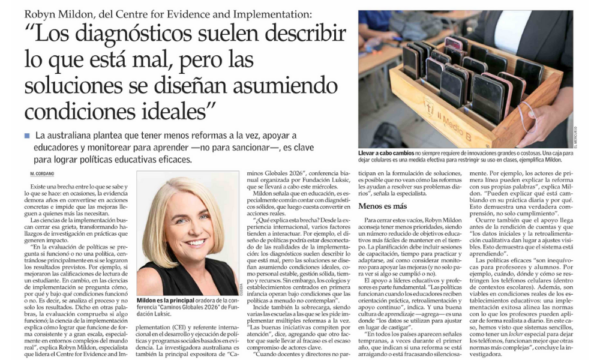
The activity was led by researcher Robyn Mildon, executive director and founder of the Centre for Evidence and Implementation (CEI), an international reference in implementation science. During her presentation, Mildon emphasized that the main challenge of public policies is not only in their design, but also in their execution: “Scaling up a policy implies that at least 60-70% of the population benefits from it. Many initiatives work in pilot projects, but fail to expand due to a lack of capacity, support and adaptation to local contexts.
“Scaling solutions that work is an ethical imperative. The challenge often lies in implementation: because the ideas are there, but the impact depends on how they are executed, the capabilities of the teams, the local context and the experience of those who benefit. If we want real changes in people’s lives, implementation cannot take a back seat,” said Macarena Cea, general manager of the Luksic Foundation.
Among the main obstacles to effective implementation, Mildon highlighted the low level of coordination between the central level and local governments, the capacity of the teams in charge of implementation and the tendency to prioritize new initiatives over the consolidation of those that need to be improved. He also stressed the need for continuous support -rather than specific training- as the key to sustaining programs over time.
The event included a panel discussion on field implementation with the participation of Lucas Palacios, rector of INACAP and former Minister of Economy; Víctor Reyes, director of the Liceo Bicentenario de Excelencia Polivalente San Nicolás, Macarena Cea and Robyn Mildon, who addressed the challenges of taking policies from design to the classroom and local services. “Through a common purpose, collaboration is facilitated. Many times, the implementation of policies does not work because there are no spaces that promote collaboration, which is triggered when there is a purpose that everyone is pursuing,” said Lucas Palacios.
“Educational transformations work when they are born from the dreams of the students,” said Víctor Reyes and recounted how exciting it has been to see mothers cry because their children will be the first in their family to study for a university degree. Listening to young people and involving teachers in the design of the programs, says the principal, has been key to the results of his high school: enrollment grew from 300 to 2,050 students, close to 90% of its graduates continue on to higher education and ten students obtained maximum scores in the PAES 2025. One of them, with double national scores, participated this Monday in the breakfast with President Gabriel Boric in La Moneda.