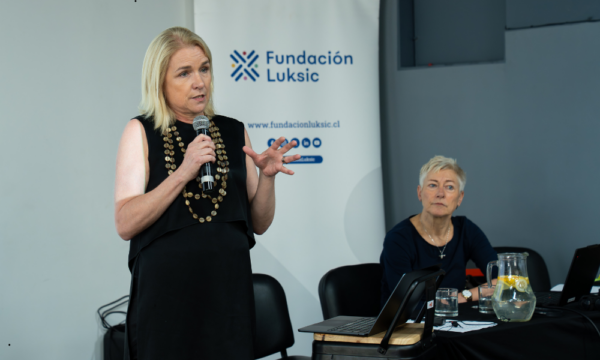
Robyn Mildon, Global Pathways 2026 panelist, discusses gaps in implementation science
In an interview with the newspaper El Mercurio, the Australian researcher and keynote speaker at Global Pathways 2026, the Luksic Foundation’s biannual conference, shared her views on the gap between evidence and implementation.
There is a gap between what is known and what is done: sometimes, evidence takes years to turn into concrete actions and prevents improvements from reaching those who need them most.
The implementation sciences seek to close this gap, transforming research findings into practices that generate impact.
Policy evaluation asks whether or not a policy worked, focusing primarily on whether the intended results were achieved. For example, whether a student’s reading scores improved. Implementation science, on the other hand, asks how, why, and under what conditions it did or did not work. In other words, the process is analyzed, not just the results. In other words, evaluation tests whether something worked; implementation science explains how to make it work consistently and on a large scale, especially in complex real-world settings,’ explains Robyn Mildon, a specialist who leads the Centre for Evidence and Implementation (CEI) and an international reference in the development and execution of evidence-based social policies and programs. The Australian researcher is also the main speaker at ‘Global Pathways 2026’, a biannual conference organized by the Luksic Foundation, which will take place this Wednesday.
Mildon points out that in education, it is especially common to have solid diagnoses, which are then difficult to turn into real actions.
What explains this gap? From international experience, several factors tend to interact. For example, policy design may be disconnected from the realities of implementation: diagnoses often describe what is wrong, but solutions are designed assuming ideal conditions, such as stable staffing, sound management, time and resources. However, early childhood-focused schools and facilities operate under conditions that policies often do not contemplate’.
Overload also plays a role, with several schools being asked to implement multiple reforms at the same time. Good initiatives compete for attention,’ he says, adding that another factor that often leads to failure is the low commitment of key stakeholders.
When teachers and principals are not involved in formulating solutions, they may not see how the reforms help them solve their daily problems,’ she says.
Less is more
To close these gaps, Robyn Mildon advises having fewer priorities, with a small number of educational objectives being easier to maintain over time. Planning should include training sessions, time to practice and adapt, and consider monitoring to support improvements (and not just to see if something was accomplished or not).
Support for educational leaders and teachers is a key part. Policies work when educators receive practical guidance, feedback and ongoing support,’ he says. And a good learning culture, he adds, is one where ‘data is used to adjust rather than punish’.
In all countries there are early signs, sometimes in the first year, that indicate whether a reform is taking root or quietly failing. For example, frontline actors can explain the reform in their own words,’ Mildon explains. ‘They can explain what is changing in their daily practice and why. This demonstrates real understanding, not just compliance.’
It also happens that support comes before accountability and that ‘initial data and qualitative feedback leads to visible adjustments. This shows that the system is learning’.
Effective policies ‘are unambiguous to teachers and students. For example, when, where and how cell phones are restricted (within school contexts). Moreover, they are workable in real school conditions: successful implementation aligns the rules with what teachers can realistically apply on a daily basis. In this case, we have seen that simple systems, such as having a special locker for leaving phones, work better than more complex rules’, concludes the researcher.