Daniel Almonte, the teacher seeking to transform education, named one of the 30 winners of the 2026 LED Awards
The principal of Colegio Bicentenario Padre Alberto Hurtado, in Chile’s Ñuble Region, was one of 30 educators recognized at the 2026 LED Awards in the Educational Innovation and 21st-Century Skills category. What has his journey looked like? This is the story of a school community that, since 2019, has sought to expand students’ learning opportunities through new subjects, music education and a culture of collaboration among teachers.
When Daniel Almonte became principal of Colegio Padre Alberto Hurtado, in Chile’s Ñuble Region, in 2019, the school had already tried unsuccessfully to join the Bicentenario Schools of Excellence network. He decided to apply again, as membership in the network provides access to additional funding to upgrade infrastructure and technical equipment, priority pedagogical support from Chile’s Ministry of Education (Mineduc), and the flexibility to adapt the current national curriculum to better reflect students’ realities and needs.
Together with his team, he decided to review the educational project of the school community, which comprises 180 staff members and 1,180 students, and ask a fundamental question: What kind of school did they dream of building? With a revised proposal, the school was selected to join the Bicentenario Schools of Excellence network. However, preparing the application also gave them an opportunity to reflect on students’ experiences and identify areas for improvement. They found challenges related to motivation, academic expectations, confidence in their own abilities and students’ lack of active involvement in their learning. These issues were reflected in low participation in academic support sessions, as well as in meetings and interviews with parents and guardians.
For Daniel, the answer could not simply be to reinforce traditional academic subjects. It was also necessary to listen to students, understand their interests and give them opportunities to develop their talents.
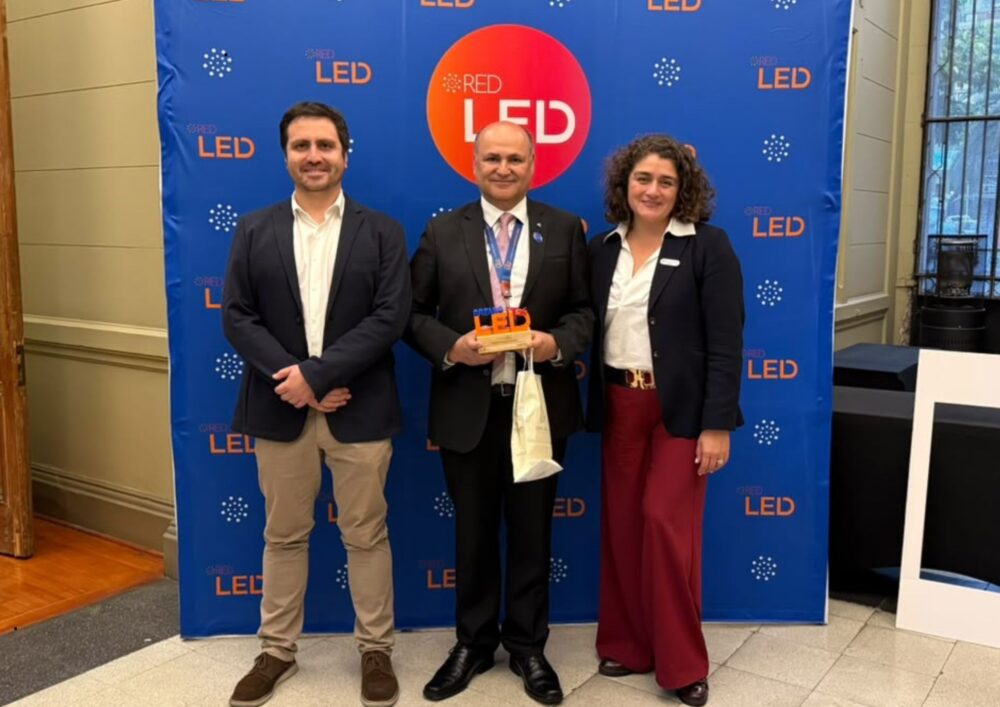
After eight years of working to implement the changes they had set out to make, Daniel was named one of 30 school leaders to receive a Líderes Educativos Directivos (LED) Award, selected from 60 finalists. He won in the Educational Innovation and 21st-Century Skills category. Organized by Fundación Impulso Docente, Fundación Mustakis and El Mercurio, the awards recognize school leaders who are transforming education in Chile.
“My main driving force is a deep desire to transform the lives of young people who have fewer opportunities and turn that into real possibilities for them. We have brought this project to life with great passion, and our teams have embraced the idea of continuous improvement,” Daniel says proudly.
“We have been fortunate to work with Colegio Padre Alberto Hurtado for the past four years and to see firsthand the innovations they have introduced to improve learning and give students a more active role in their education. One example is their work with the Redes Educativas para la Mejora de Aprendizajes (REMA) program. In addition to applying this methodology in Language Arts and Mathematics through classroom recordings and feedback from fellow teachers and specialists, they have decided to extend it to other subjects. This shows how trust in teachers and collaborative work can create new opportunities to improve student learning,” said Macarena Cea, General Manager of Fundación Luksic.
Social-emotional learning, music education and multilingualism
The journey began with small-scale initiatives that the school gradually refined as it observed their results. One of these was the introduction of classes focused on emotions, where children learn to regulate their emotions, manage conflict, listen to and care for their classmates, Daniel explains. He says the initiative has helped reduce the number of incidents involving school coexistence.
Music education was another initiative. The school orchestra started with just seven students and now has around 100 members. In total, more than 400 students, from pre-kindergarten through their final year of secondary school, take part in what the school calls “Open Music Education Classrooms,” where they can learn to play instruments such as the violin, cello, flute and percussion.
The initiative aims to give students opportunities to pursue their interests and strengthen skills such as perseverance, autonomy and teamwork. “We have seen them develop their full potential by doing what they love, and this has also led to better results in Mathematics. The answer is not to give them more hours of Mathematics, but to give them opportunities to do things they enjoy,” Daniel says.
The same approach has been extended to other areas. Through Digital Literacy, a subject collaboratively designed by teachers, more than 500 students from fifth grade through the second year of secondary school develop technological skills. Following the interest it generated, the school introduced open classrooms in programming, robotics and computational thinking.
The school also implemented a multilingual education program that allows students to choose between Chinese and German in addition to English. International certifications and exchange programs, Daniel says, have broadened their learning opportunities and exposure to other cultures.
Rather than simply adding activities, the goal is to make learning meaningful and prepare students to thrive in a globalized world. “It is about listening to young people, understanding what they enjoy, and not limiting ourselves to remedial classes and traditional subjects,” he says.
Building a culture of trust to improve teaching
To sustain these changes, the school has also worked on how teachers prepare their lessons and collaborate with one another. Through Redes Educativas para la Mejora de Aprendizajes (REMA), a Fundación Luksic program, teachers began recording their classes, reviewing the videos and receiving feedback to identify opportunities for improvement.
This work includes Professional Learning Communities, in which teachers meet regularly to review their practices, observe one another’s classes and share strategies. The aim is to ensure that classroom observation is not punitive, but rather an opportunity for collective reflection and improvement.
Daniel recalls that, in the past, classroom observations took place once or twice a year and were conducted either by a member of the school’s leadership team or by an external company. They were evaluative in nature. “There was no evidence of pedagogical reflection processes or opportunities for teacher collaboration,” he says. “REMA has helped us take a closer look at our own practices, see how we can improve and, in turn, better support our children and young people,” he adds.
For the principal, this way of working requires trust and a shared purpose: teachers must have the autonomy to propose changes, and those decisions must translate into better opportunities for students. He explains that the classroom environment and the relationships students build with their teachers are part of the conditions that make learning possible.
This approach and the innovations introduced have been accompanied by improvements in the school’s academic results compared with previous assessments, although results have fluctuated in recent years.
Daniel explains that these figures are part of a broader improvement process that combines academic work with initiatives focused on motivation and students’ overall development. “Integrating 21st-century skills is part of our Institutional Educational Project (PEI), which is committed to equal opportunities and to preparing students for the challenges of a globalized society,” he says.
The journey that led Daniel Almonte to receive an LED Award began with a question about the school they wanted to build. Today, that vision is reflected both in the opportunities available to students and in a culture of collaboration and trust among those who support their learning.