Researchers from Belgium assessed the potential of Chilean forests for advancing scientific knowledge
- A delegation from Ghent University, an international leader in temperate forest ecology, visited Pirinel Park—a conservation initiative of the Luksic Foundation—to learn about its research efforts and explore opportunities for scientific collaboration.
Which forest species will be able to adapt to an increasingly warmer climate? Which ecosystem services are most vulnerable to global change? And how can we conserve ecosystems that are home to high biodiversity? These are some of the questions guiding the work of researchers from Ghent University in Belgium, who recently visited Pirinel Park to study one of southern Chile’s temperate rainforests.
The delegation is part of a group of scholars studying how climate change is transforming forest ecosystems in different parts of the world. Their research is being conducted in countries such as Belgium, Ecuador, Panama, and French Guiana, where they combine long-term experiments, environmental sensors, satellite imagery, and three-dimensional models to understand how forests are changing and what this means for people.
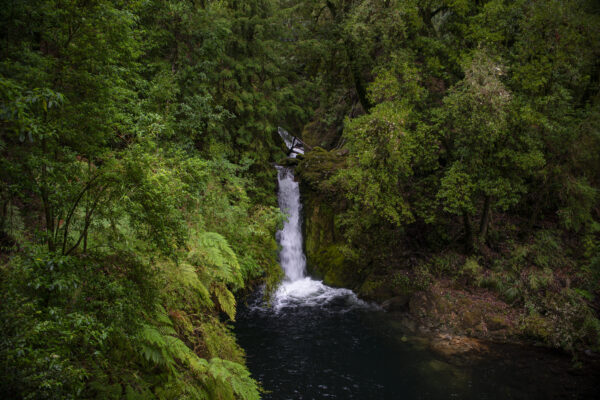
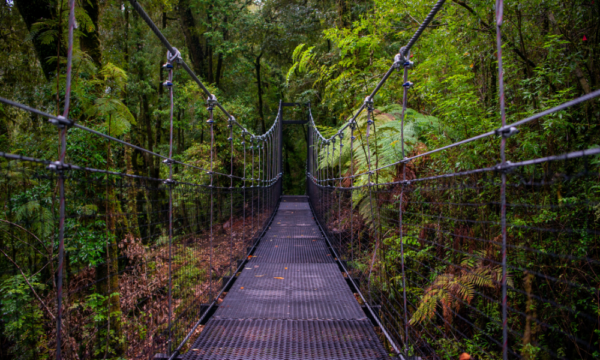
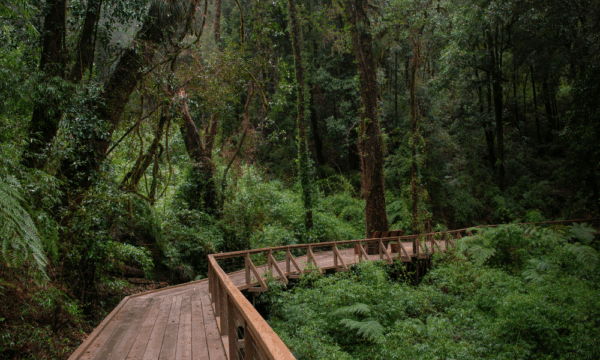
Pirinel Park is a conservation initiative of the Luksic Foundation located in the Los Ríos Region, covering more than 12,000 hectares, with areas designated for scientific conservation and public access. The public can explore more than 10 km of trails—including an accessible boardwalk over 500 meters long and four overlooks—in one of the country’s most biodiverse areas, home to a wealth of valuable plant and animal species.
“The goal of the Parque Pirinel project is to dedicate this space to conservation and science—not only protecting biodiversity, but also promoting knowledge and research to contribute to the development of a more sustainable Chile,” explained Macarena Cea, general manager of the Luksic Foundation.
Since its inception, the Foundation has worked alongside national and international universities to conduct research in the park. More than 50 academics have collaborated to lay the groundwork for studying species such as the pudú, Darwin’s frog, the güiña, the puma, the native forests, and the area’s water resources. The park also has camera traps and weather sensors installed in various sectors and at different elevations to observe, understand, and protect this ecosystem.
For Belgian researchers, the park has some unusual characteristics. “Pirinel is a special ecosystem for us because it combines features of temperate forests with elements we usually associate with tropical forests, such as the presence of epiphytes—like moss—and lianas. That makes it an interesting place for research and conservation,” said Hans Verbeeck, associate professor at the Faculty of Bioscience Engineering and co-leader of the Q-ForestLab at Ghent University.
Verbeeck added that one of the motivations for the visit was precisely to question the assumptions on which European research is based: “We study temperate forests in Europe and often generalize those results to the rest of the planet’s temperate zones. However, Chile’s rainforests may differ significantly in their composition, structure, and functioning, which raises some very interesting scientific questions.”
The researchers also noted that Chile offers rare conditions for studying the effects of climate change on biodiversity: in addition to having vast natural areas with minimal human impact, its north-to-south extent allows scientists to observe how species respond to different climates and how they might shift as temperatures rise.
The visit also included meetings with researchers from Chilean universities and research centers in the Los Ríos Region, where they exchanged experiences and discussed potential joint projects. The next steps aim to define specific lines of research that will generate evidence to guide conservation strategies in the temperate forests of southern Chile.